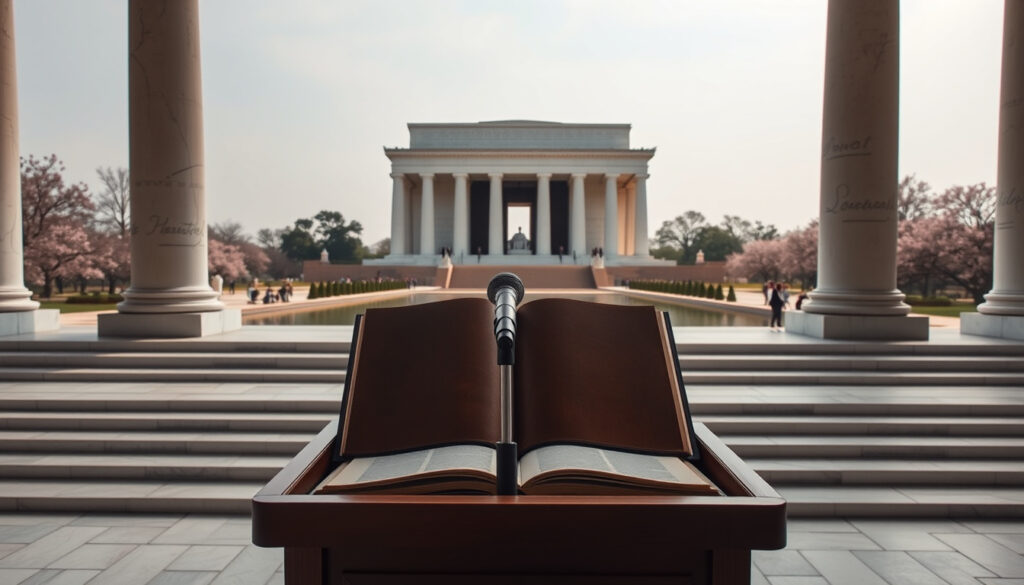
I Have a Dream – Full Text Analysis and Historical Context
On August 28, 1963, Martin Luther King Jr. stood before a quarter of a million people at the Lincoln Memorial and delivered a speech that would echo through American history. Known by its refrain, “I Have a Dream,” the address did not just capture the hopes of the civil rights movement — it reshaped the moral language of the nation. Combining biblical cadence, constitutional argument, and a vision of racial reconciliation, it remains one of the most analyzed and quoted pieces of American oratory.
The speech was the climax of the March on Washington for Jobs and Freedom, a mass demonstration that demanded civil rights legislation and economic justice. King’s message threaded together a rejection of gradualism, a demand for immediate action, and a hopeful portrait of a future where children would be judged by character rather than color. It was a balancing act between indictment and inspiration.
What Is the Full Text of Martin Luther King Jr.’s ‘I Have a Dream’ Speech?
Martin Luther King Jr.
August 28, 1963
Lincoln Memorial, Washington D.C.
March on Washington for Jobs and Freedom
The complete transcript runs approximately 1,600 words and takes about 16 minutes to deliver. The full text is freely available through multiple archives, including the American Rhetoric website, which provides a verbatim transcript alongside an audio recording. A PDF excerpt is also hosted by the Gilder Lehrman Institute, offering a classroom-ready version of key passages. The Wikipedia article on “I Have a Dream” provides a reliable overview with citations to primary sources. For readers interested in how structure and persuasion work together in writing, the guide on How to Write a Personal Statement – Structure, Tips and Examples offers a useful parallel.
Key insights about the speech
- The speech was not originally in King’s prepared remarks; it was improvised after Mahalia Jackson urged him to “Tell them about the dream, Martin.”
- The phrase “I have a dream” appears approximately 9 times, depending on which transcript version is consulted.
- King drew heavily on biblical language, the American dream, and the Declaration of Independence.
- The speech is credited with helping to pass the Civil Rights Act of 1964 and the Voting Rights Act of 1965.
- Even today, the speech is one of the most quoted American addresses and is studied globally for its rhetoric.
| Fact | Value |
|---|---|
| Duration | Approximately 16 minutes |
| Audience | About 250,000 people |
| Word count | ~1,600 words |
| Broadcast | Live on national television |
| Legacy | Listed as a UNESCO Memory of the World document (2015) |
When and Where Was the ‘I Have a Dream’ Speech Delivered?
King delivered the address on August 28, 1963, from the steps of the Lincoln Memorial in Washington, D.C. The occasion was the March on Washington for Jobs and Freedom, a massive demonstration that brought together civil rights organizations, labor unions, and religious groups. The event was designed to pressure the federal government to pass comprehensive civil rights legislation.
What Was the Occasion?
The march was organized by a coalition led by A. Philip Randolph and Bayard Rustin. Participants traveled by bus, train, and car from across the country to gather before the memorial. The crowd, estimated at 250,000, stretched from the Lincoln Memorial to the Washington Monument. The day included performances, speeches from various movement leaders, and a closing address from King.
How Many People Attended?
Most historical sources place the crowd at roughly 250,000, though some accounts cite figures as low as 200,000. The exact number is difficult to confirm because the National Park Service did not issue an official estimate at the time. Contemporary news reports and photographs suggest the crowd filled the entire Reflecting Pool area and extended onto the surrounding lawns.
The march was one of the largest political rallies for human rights in United States history. It is widely credited with building the public pressure that led to the Civil Rights Act of 1964 and the Voting Rights Act of 1965, both passed in the years immediately following the event.
How Many Times Did Martin Luther King Say ‘I Have a Dream’?
The number of repetitions varies depending on whether you count from the audio recording or from the written transcript that King prepared beforehand. In the delivered speech, the phrase “I have a dream” occurs approximately nine times. However, because the final portion of the speech was largely improvised, different transcriptions sometimes count seven, eight, or ten iterations. The most widely accepted count is nine.
Did MLK Improvise the ‘I Have a Dream’ Refrain?
Yes, the dream sequence was not part of the text King had prepared for the day. According to those present, the gospel singer Mahalia Jackson, standing near the podium, called out: “Tell them about the dream, Martin.” King set aside his prepared notes and began the improvisation that produced the most memorable passage of the speech. This is why the written transcript that circulated before the event does not include the repeated “I have a dream” lines.
Is There a Difference Between the Written Text and the Spoken Version?
The prepared text was shorter and more tightly scripted. The spoken version is longer, more repetitive, and more emotionally charged. The written version that King carried with him contained a line about “the dream” — drawn from a speech he had given earlier in Detroit — but the extended refrain that made the address famous was created in the moment. This improvisation is one reason the exact count of the phrase remains debated among scholars.
What Are the Key Themes and Rhetorical Devices in the Speech?
The speech is structured around a central argument: America promised liberty and equality to all its citizens, but has failed to deliver that promise to Black Americans. King uses a series of rhetorical strategies to make this case, blending legal reasoning with prophetic language.
The Main Message
King argues that Black Americans were promised equality by the nation’s founding ideals, those promises had not been fulfilled, injustice must be confronted now, and America can still become a just, integrated society. This arc from indictment to hope defines the speech’s emotional and logical structure.
Key Rhetorical Devices
- Anaphora — Repeated beginnings: “I have a dream,” “Now is the time,” “Let freedom ring.” This builds momentum and makes the speech memorable.
- Metaphor — “Bad check,” “promissory note,” “dark and desolate valley of segregation,” “sunlit path of racial justice.” These convert abstract injustice into concrete images.
- Biblical allusion — “Every valley shall be exalted,” “Let justice roll down like waters.” These give the speech moral authority and connect civil rights to a sacred tradition.
- Allusion to founding documents — The Declaration of Independence is quoted directly: “We hold these truths to be self-evident, that all men are created equal.” This frames civil rights as the fulfillment of American ideals.
- Pathos — Emotion is evoked through imagery of children, brotherhood, and shared human dignity. The famous line about children judged “not by the color of their skin but by the content of their character” is a direct appeal to empathy.
- Ethos — King’s credibility flows from his role as a minister and his leadership of the movement.
- Logos — The argument is structured logically: America made a promise, the promise has not been kept, justice requires action now.
- Parallelism — Repeated grammatical patterns create rhythm and clarity throughout the text.
- Symbolism — Mountains, valleys, and the ringing of freedom bells symbolize national transformation.
- Call to action — The speech demands continued struggle, discipline, unity, and nonviolent persistence.
The “bad check” metaphor is one of the most effective in the speech. King says America has given Black citizens a check marked “insufficient funds,” but the nation must honor its obligations. The metaphor turns a legal concept into a moral indictment, making abstract injustice feel concrete and urgent. For a deeper look at how rhetorical strategies shape influence, the 48 Laws of Power – Complete List and Key Insights examines similar principles of persuasion and positioning.
Some modern analyses point out that King’s vision of a colorblind society has been interpreted in different ways since 1963. While the speech called for judging by character rather than skin color, the debate over how to achieve that ideal — through equality of opportunity or equality of outcome — continues among scholars and activists today.
Why Is the ‘I Have a Dream’ Speech So Influential?
The speech’s influence stems from its timing, its rhetorical power, and its ability to translate a political struggle into a moral vision that reached beyond the civil rights movement. It was broadcast live on national television, giving millions of Americans their first extended exposure to King’s oratory.
How Did the Speech Affect the Civil Rights Movement?
The March on Washington and King’s address created a sense of national urgency. Within a year, the Civil Rights Act of 1964 was passed, followed by the Voting Rights Act of 1965. While the speech was not the sole cause of these legislative victories, it is widely regarded as a turning point that shifted public opinion and increased political pressure on Congress.
What Is the Speech’s Legacy Today?
The speech continues to be cited in movements for racial justice, including the Black Lives Matter movement. It is studied in schools around the world as a model of persuasive rhetoric. In 2015, it was listed on the UNESCO Memory of the World register, recognizing its global historical significance. The King Center continues to preserve and promote King’s legacy, including the full text and recordings of the speech.
What Events Led Up to and Followed the ‘I Have a Dream’ Speech?
- 1955–1963 — Civil rights movement gains momentum: Montgomery Bus Boycott, sit-ins, Freedom Rides.
- June 11, 1963 — President Kennedy delivers a civil rights address, proposing new legislation.
- August 28, 1963 — March on Washington; King delivers “I Have a Dream” speech.
- September 15, 1963 — 16th Street Baptist Church bombing in Birmingham, which increased the speech’s poignance.
- 1964 — Civil Rights Act passed.
- 1965 — Voting Rights Act passed.
- Present — Speech remains a symbol of racial justice and equality, frequently referenced in public discourse.
What Details About the Speech Are Certain and What Remains Unclear?
| Established information | Information that remains unclear |
|---|---|
| The speech was delivered on August 28, 1963 at the Lincoln Memorial. | Exact number of “I have a dream” repetitions varies between 7 and 10 depending on the transcript (audio vs. written). |
| King used the refrain “I have a dream” repeatedly. | Whether King fully improvised the dream section or had partially drafted it is debated by historians. |
| The speech is a cornerstone of American oratory. | Some sources report the audience as 200,000, while 250,000 is also widely cited. |
What Was the Historical Significance of the ‘I Have a Dream’ Speech?
The speech was delivered at a moment of intense national conflict over segregation and racial violence. The March on Washington was organized to pressure Congress to pass civil rights legislation that President Kennedy had proposed two months earlier. King’s address succeeded in framing the civil rights struggle as a fulfillment of American ideals rather than a rejection of them. This approach — combining moral force with national inclusion — made the speech politically effective as well as emotionally powerful. The National Archives holds records of the march and the legislative response that followed, documenting how the event influenced the passage of landmark civil rights laws.
Where Can I Find the Original Text and Audio of the Speech?
“I have a dream that my four little children will one day live in a nation where they will not be judged by the color of their skin but by the content of their character.”
— American Rhetoric transcript
“Let freedom ring from the prodigious hilltops of New Hampshire…”
— Gilder Lehrman PDF excerpt
“We hold these truths to be self-evident: that all men are created equal.”
— Declaration of Independence, quoted by King in the speech
The full transcript is available through American Rhetoric, which also hosts an audio recording of the original delivery. The Gilder Lehrman Institute provides a PDF excerpt with key passages suitable for classroom use. The National Archives holds photographs, documents, and legislative records from the March on Washington.
What Is the Lasting Impact of the ‘I Have a Dream’ Speech?
Six decades after it was delivered, Martin Luther King Jr.’s “I Have a Dream” speech remains a reference point for discussions of racial justice in the United States and beyond. Its phrases appear in political speeches, protest signs, and classroom lessons. The speech continues to be studied not only for its historical significance but also as a masterclass in persuasion — a demonstration of how language can translate political struggle into moral vision. The King Center continues to preserve and promote King’s legacy, including the full text and recordings of the speech. For those interested in how rhetoric shapes power, the speech offers lessons that extend well beyond its original context.
Frequently Asked Questions
What is the book “I Have a Dream”?
There are several books titled “I Have a Dream.” The most common is a children’s picture book that reproduces King’s speech alongside illustrations. There is also a collection of King’s writings published under the same title.
How does the ABBA song “I Have a Dream” relate to the speech?
The ABBA song is unrelated. It is a pop song about hope and perseverance released in 1979. The title is a coincidence and was not inspired by King’s speech.
Is the speech under copyright?
The speech is in the public domain. King’s estate has claimed copyright at various points, but the text is widely considered freely available for educational and non-commercial use.
Can I use the speech text for a school project?
Yes. The speech is freely available for educational use. When citing, provide attribution to Martin Luther King Jr. and note the date and occasion of delivery.
Where can I find an audio recording of the speech?
Audio recordings are available through American Rhetoric, the National Archives, and the King Center. Many versions are also hosted on YouTube and other public platforms.
How long did it take to write the speech?
King worked on the speech over several days before the march, but the famous “I have a dream” refrain was largely improvised during delivery.
What is the most famous line from the speech?
The most quoted line is “I have a dream that my four little children will one day live in a nation where they will not be judged by the color of their skin but by the content of their character.”
Was the speech well received at the time?
Yes. The crowd responded with sustained applause and cheering. News coverage was largely positive, and the speech was praised by political leaders across the spectrum.
Did Martin Luther King Jr. give other famous speeches?
Yes. Other notable addresses include “I’ve Been to the Mountaintop” (delivered the day before his assassination) and “Letter from Birmingham Jail,” a written text that is also widely studied.
What does the “bad check” metaphor mean in the speech?
King argues that America’s founding documents promised liberty to all citizens, but Black Americans received a “bad check” marked “insufficient funds.” He calls on the nation to honor its promise.
More related posts
 National Theatre at Home – How to Watch Cost and Best Plays
 Lewis Capaldi Ex Girlfriend – Paige Turley Song Story
 Keke Palmer Movies and TV Shows – Complete Filmography and Best Roles
 India National Cricket Team vs Pakistan National Cricket Team Stats – Head-to-Head Records 1952-2026
 Tom Ellis – Height, Wife, Net Worth, Age and Movies
 Matt Tebbutt – Biography TV Career Wife and Net Worth
 Leeds United News Now Every 5 Minutes – Live Updates and Trusted Sources
 Time in Melbourne Now – Current AEST, DST and Time Zone Guide