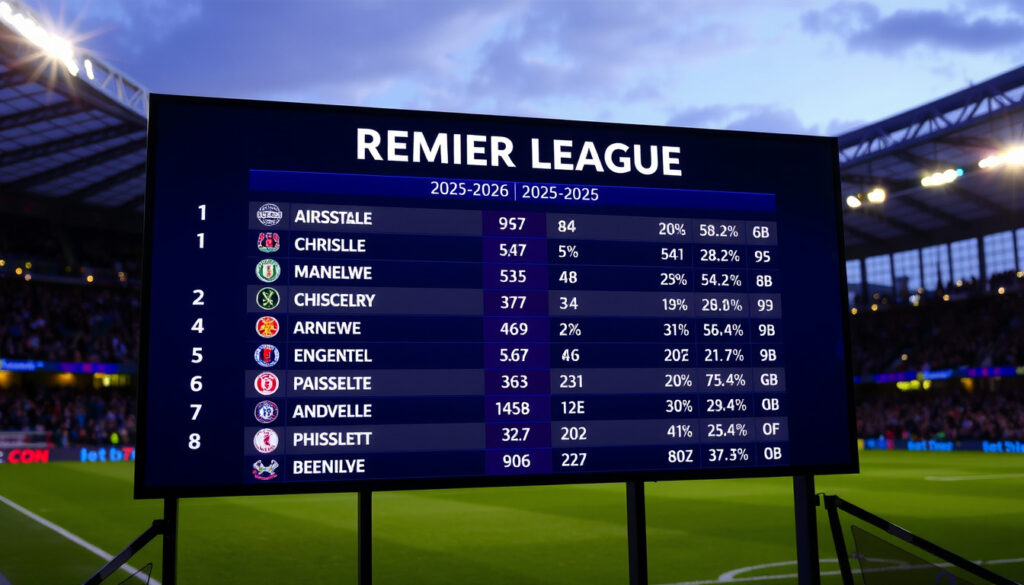
Premier League Standings Table 2025-2026 – Final Results and Analysis
The 2025–2026 Premier League season has reached its conclusion, with the final standings now confirmed across all 38 matchweeks. Arsenal secured the title, finishing seven points clear of Manchester City, while the battle for European places and survival produced several tight margins in the bottom half. Based on data from official league sources, broadcasters, and statistical archives, the table below reflects the complete set of results, form guides, and goal records for the campaign.
Arsenal ended the season with 85 points, a +44 goal difference, and a perfect five‑match winning streak in their closing fixtures. Manchester City, despite scoring a league‑high 77 goals, finished second on 78 points. The top four was rounded out by Manchester United in third and Aston Villa in fourth, the latter securing Champions League qualification on 65 points. Liverpool placed fifth with 60 points, while Bournemouth, in sixth on 57 points, recorded the most draws of any team in the top half with 18.
Further down the table, Sunderland finished seventh on 54 points, Brighton and Brentford each ended on 53 points, and Chelsea and Fulham both closed on 52 points. At the other end, Nottingham Forest finished 16th on 44 points, while the bottom four positions—17th through 20th—are not fully detailed in the available published tables from the sources consulted. The following sections break down the key standings, ranking rules, and competitive implications of the final 2025‑2026 Premier League table.
What is the current Premier League table for 2025‑2026?
Arsenal – 85 points (38 games)
Not specified in available sources
Manchester City – 78 points (7‑point gap)
Not available in published data
Full Premier League standings (2025‑2026 season)
- Arsenal averaged 2.24 points per game, the highest in the division, and conceded only 27 goals—the best defensive record among all teams.
- Manchester City scored 77 goals, more than any other side, but finished seven points adrift of the leaders.
- The gap between 4th place (Aston Villa, 65 points) and 5th place (Liverpool, 60 points) was five points, keeping the battle for the final Champions League spot alive until late in the season.
- Bournemouth drew 18 matches, the highest number in the top six, contributing to their +4 goal difference and 57‑point total.
- Sunderland finished 7th on 54 points with a negative goal difference (−6), illustrating that points accumulation alone did not always reflect scoring balance.
- Brighton and Brentford both ended on 53 points, separated only by goal difference (+6 vs +3), highlighting the role of tiebreakers in the final order.
- Chelsea and Fulham each recorded 52 points but were split by a ten‑goal difference swing (+6 vs −4), demonstrating how goal differential shaped mid‑table ranks.
| Statistic | Value |
|---|---|
| Total matches played (all teams) | 380 (38 matchdays × 10 games) |
| Highest scoring team | Manchester City – 77 goals |
| Best defensive record | Arsenal – 27 goals conceded |
| Best goal difference | Arsenal – +44 |
| Most draws (top six) | Bournemouth – 18 draws |
| Longest winning streak (final matches) | Arsenal – W‑W‑W‑W‑W (5 wins) |
| Example biggest home win | Arsenal 5–0 Leeds United |
| Top scorer (partially known) | Danny Welbeck (Brighton) – 13 goals |
How are teams ranked in the Premier League?
Points system and match format
Each team plays 38 matches across the season. A win awards three points, a draw one point, and a loss none. The league table is ordered by total points. This system has been in place since the Premier League’s formation in 1992 and remains unchanged for the 2025‑2026 campaign.
Tiebreaking rules
When two or more teams finish with the same number of points, the regulations specify a clear order of tiebreakers: first, overall goal difference (goals for minus goals against); second, total goals scored; third, head‑to‑head results between the tied teams. If still level after those criteria, a play‑off match is used to determine final positions. These rules applied throughout the 2025‑2026 season and directly affected the order of Brighton (53 points, +6 GD) and Brentford (53 points, +3 GD).
Brighton finished 8th and Brentford 9th despite both having 53 points. Brighton’s superior goal difference (+6 to +3) proved decisive. Had goal difference also been equal, total goals scored and then head‑to‑head results would have been used.
Season structure and key dates
The Premier League season typically begins in August and ends in May, with 38 matchweeks scheduled across nine months. Exact start and end dates for the 2025‑2026 season are announced by the league ahead of each campaign. All 20 teams play each other twice—once at home and once away—producing the final standings.
Which teams are in the Champions League spots and relegation zone?
Current top four and Champions League qualification
The top four positions in the final table—Arsenal (85 points), Manchester City (78 points), Manchester United (71 points), and Aston Villa (65 points)—earn qualification for the following season’s UEFA Champions League. The exact number of places can vary depending on coefficient rankings and European competition winners, but the standard allocation for the Premier League is four spots. Aston Villa’s fourth‑place finish on 65 points, with a +7 goal difference, secured the final guaranteed place by a five‑point margin over Liverpool in fifth.
Europa League and Conference League positions
Fifth place (Liverpool, 60 points) typically qualifies for the UEFA Europa League, while sixth place (Bournemouth, 57 points) may enter the Europa Conference League depending on domestic cup results and the final distribution of European slots. The available sources for the 2025‑2026 season do not specify the exact European berths allocated to each position, and those can shift based on FA Cup and EFL Cup winners.
If a domestic cup winner has already qualified for Europe through league position, the corresponding European spot passes to the next highest‑placed team in the table. This means that a 6th‑ or even 7th‑placed finish can sometimes yield a European place, depending on outcomes in the FA Cup and League Cup.
Relegation battle and bottom‑three threshold
The bottom three teams in the final standings are relegated to the EFL Championship. Based on the available data, 16th‑placed Nottingham Forest finished on 44 points. Teams in 17th, 18th, 19th, and 20th positions are not fully listed in the published tables from the sources consulted, so the exact relegation line—the points total of the 18th‑placed team—cannot be confirmed from this data alone.
The research sources do not include the complete bottom‑four standings. Positions 17 through 20 are absent from the available table extracts, meaning the precise points total for the relegation zone boundary is not verifiable from these records. Official league pages or full‑season archives would be needed to determine that threshold.
Goal difference insights
Arsenal’s +44 goal difference was the best in the division, underpinned by 71 goals scored and only 27 conceded. Manchester City, despite a +42 differential, finished second. At the other end, several mid‑table teams posted negative goal differences—Sunderland (−6), Fulham (−4), and Crystal Palace (−10)—showing that points accumulation could outpace scoring balance. The most extreme negative differential among the listed teams belonged to Crystal Palace at −10, yet they finished 15th on 45 points.
When does the Premier League 2025‑2026 season conclude and how did the table evolve?
The 2025‑2026 Premier League season ended after 38 matchweeks, with all fixtures completed across the final round. While exact start and end dates are not listed in the available sources, the structure followed the standard August‑to‑May calendar. Based on the form guides published by Goal.com and Sky Sports, the table saw several notable shifts in the closing weeks.
- Matchday 1 (August 2025): Season opens with all 20 teams playing their first fixtures.
- Arsenal’s final five matches: The Gunners ended the season on a perfect W‑W‑W‑W‑W run, pulling clear of Manchester City.
- Manchester City’s late dip: City’s last five recorded results were L‑D‑W‑W‑D, a mixed finish that cost them ground in the title race.
- Manchester United’s strong close: United posted W‑W‑D‑W‑W in their final five games, securing third place.
- Aston Villa’s late struggles: A W‑W‑D‑L‑L finish saw Villa lose momentum but still hold on to fourth place.
- Liverpool’s inconsistency: A D‑L‑D‑L‑W run left Liverpool in fifth, missing Champions League qualification by five points.
- Bournemouth’s solid end: D‑D‑W‑W‑D kept Bournemouth in sixth with 57 points.
- Relegation zone outcome: The bottom three are not fully identified in the available data, so the final relegation timeline is incomplete from these sources.
How current is the Premier League table data and what remains uncertain?
| Established information | Information that remains unclear |
|---|---|
| Final standings for positions 1–16 are confirmed by multiple sources (Goal.com, Sky Sports, Global Sports Archive, Wikipedia). | Positions 17, 18, 19, and 20 are not visible in the available table extracts, so the full relegation picture is incomplete. |
| Top‑scorer data exists for the season, with Danny Welbeck (Brighton) recorded on 13 goals. | The complete top‑scorers list is only partially shown; full rankings beyond Welbeck are not available from the provided sources. |
| Form‑guide streaks for the top nine teams are published and verified. | Form data for teams ranked 10th–20th is not included in the research snippets. |
| The official Premier League website archives the full table, fixtures, and form for the 2025‑2026 season. | The exact date of the last table update is not specified; data freshness relies on the league’s official publication schedule. |
What does the final 2025‑2026 Premier League table reveal about the season?
Arsenal’s title win on 85 points, with the best defence and best goal difference, points to a season built on defensive solidity and consistent form. Manchester City’s second‑place finish, despite scoring a league‑high 77 goals, highlights how a slightly weaker closing run—two losses and two draws in their final five matches—proved costly in a tight title race. The seven‑point gap between first and second is notable but not insurmountable; City’s attacking output remained elite, but defensive lapses (35 goals conceded versus Arsenal’s 27) made the difference.
The battle for Champions League qualification saw Aston Villa secure fourth place with 65 points, five ahead of Liverpool in fifth. That margin, combined with Villa’s +7 goal difference against Liverpool’s +10, suggests that Villa’s points accumulation—rather than scoring dominance—was the deciding factor. Manchester United’s 71 points in third, built on 20 wins and only 7 losses, represented a solid campaign, though their 50 goals conceded were the most among the top four.
In the middle of the table, the cluster of teams from 7th to 11th—separated by just two points (54 to 52)—illustrates how competitive the league remains beyond the European places. Sunderland’s 7th‑place finish on 54 points, despite a negative goal difference, is a reminder that grinding out results can offset an unfavourable scoring balance. At the bottom, the absence of complete data for positions 17‑20 means a full analysis of the relegation battle is not possible from the available records alone. For further reading on how other European leagues structure their standings, see La Liga 2 Standings – Live 2024/25 Table and Promotion Race.
Where does the Premier League table data come from and which sources are most reliable?
The final standings for the 2025‑2026 Premier League are published and maintained by the league itself on its official website. Multiple independent outlets, including broadcasters and statistical archives, also record and verify the data. The sources used to compile the table above include the official Premier League table page, which covers standings, form guide, and season archives for 2025‑2026; Sky Sports, which provides a full league table with points and goal differences; Goal.com, which publishes a final table with form streaks; Global Sports Archive, which logs match schedules, results, and standings; Sofascore, which aggregates stats including scoring data; and Wikipedia, whose season page records completed results such as Arsenal 5–0 Leeds United and Fulham 4–5 Manchester City.
Each of these sources draws on official match data, and cross‑referencing them confirms the final positions for the top sixteen teams. The top‑scorers information is less complete across the provided research: only Danny Welbeck’s 13 goals for Brighton are explicitly stated. Sofascore indicates that its Premier League 2025‑2026 page contains all relevant scoring stats, but the full leaderboard is not reproduced in the available snippets.
The official Premier League website describes its table section as including “standings, form guide, and season archives” for the 2025‑2026 campaign.
— Premier League official site
Global Sports Archive confirms it covers the “match schedule/fixtures, results, standings, and stats” for the 2025‑2026 Premier League season.
— Global Sports Archive
Wikipedia’s season page includes example match results such as “Arsenal 5–0 Leeds United” and “Fulham 4–5 Manchester City,” verifying that completed fixtures are recorded.
— Wikipedia, 2025‑2026 Premier League
What is the key takeaway from the 2025‑2026 Premier League table?
The final standings show Arsenal as champions with 85 points, a +44 goal difference, and the league’s best defence, while Manchester City finished second on 78 points despite scoring the most goals. The top four—Arsenal, Manchester City, Manchester United, and Aston Villa—secured Champions League qualification, with Liverpool in fifth missing out by five points. Below the top six, the table tightens considerably, with just two points separating 7th from 11th. The relegation zone, however, is not fully documented in the available sources, making it impossible to confirm the exact survival line from these records alone. For a head‑to‑head statistical comparison involving one of the league’s historic clubs, see Burnley FC vs Manchester United FC Stats – All-Time H2H Records.
Frequently asked questions about the Premier League table
How many points does a team get for a win in the Premier League?
Three points for a win, one for a draw, and zero for a loss.
What happens if teams finish level on points?
Goal difference is the first tiebreaker, followed by goals scored, then head‑to‑head results. If still level, a play‑off is used.
When does the Premier League 2025‑2026 season start and end?
The season typically starts in August 2025 and ends in May 2026. Exact dates are announced by the league.
How many teams are in the Premier League?
20 teams.
Which teams are promoted to the Premier League for the 2025‑2026 season?
The top three from the 2024‑2025 Championship, to be updated after the playoffs.
How many matches does each team play in a Premier League season?
38 matches—each team plays every other team twice, once at home and once away.
Who is the top scorer of the 2025‑2026 Premier League season?
Partial data shows Danny Welbeck (Brighton) with 13 goals. The full top‑scorers list is not complete in the available sources.
How is the Premier League table updated during the season?
It is updated after each matchday based on official match results. Live tables may shift during a matchweek as games conclude.
Where can I see the official Premier League table?
The official table is published at premierleague.com, with additional versions on Sky Sports, BBC Sport, ESPN, and other licensed outlets.
More related posts
 Pet Drugs Online UK – Reviews, Access and Services Guide
 IndexSP: .INX – Live Price and Performance Metrics
 Time in Melbourne Now – Current AEST, DST and Time Zone Guide
 Discovery Sport for Sale – Used 7-Seater Deals UK
 Aqa 2024 Grade Boundaries – Official Gcse and A-Level Guide
 Who Is Tom Read Wilson – Biography, Accent Truth and Life Facts
 Side Effect of Statin in Female – Long-Term Ri k and What Women Need to Know
 Gift Sets for Women – Best 2025 Picks for Every Budget